Every collision repair owner considering the future has to face serious questions of what comes next. For some that means a son or daughter stepping into the business. For others it's a longtime GM who has earned a real conversation about ownership. For plenty more it's an unsolicited call from a consolidator. For many it's the realization that after decades of building something valuable, it's time to think seriously about an exit.
For those who are heading down a path that includes the sale of the business, there's one question that gets dismissed too quickly more than any other: is this something to handle yourself, or one of those moments where bringing in an expert actually pays off? The data supporting hiring a professional is harder to argue with than most owners realize.
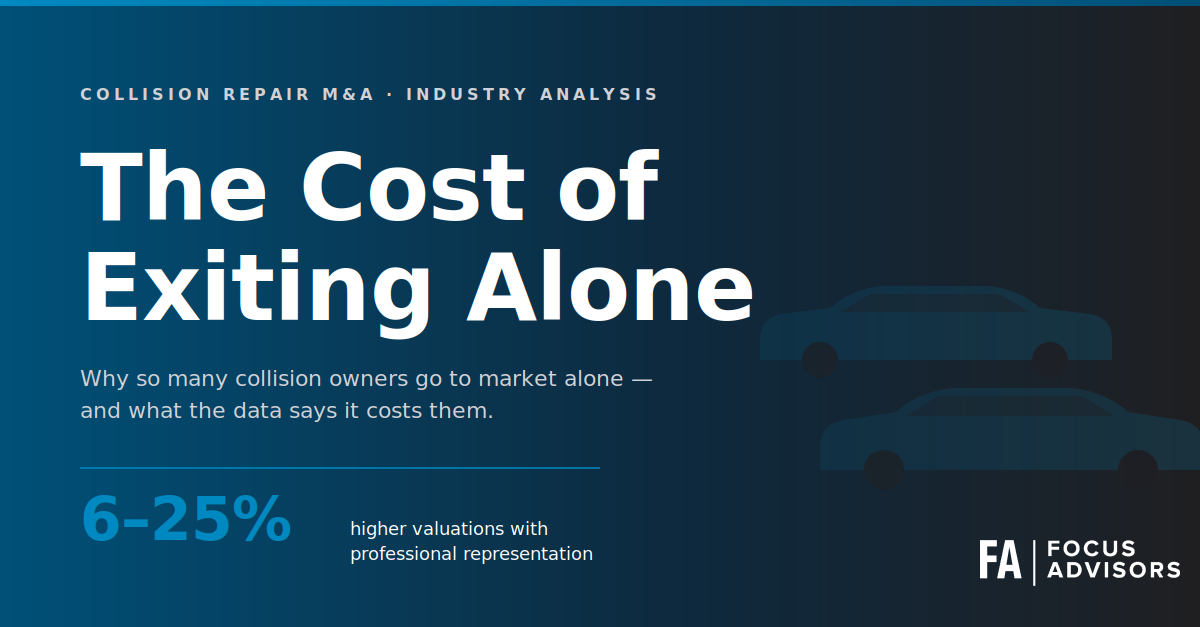
A peer-reviewed study published in the Quarterly Journal of Finance* examined more than 3,000 private company sales and found that sellers with professional representation received 6–25% higher valuations than those who went it alone. More striking: more than half of all private sellers in the study went unrepresented anyway — despite being outgunned at the negotiating table by buyers and their teams who do this for a living.
In collision repair, that asymmetry is more extreme than in almost any other industry.
The buyer side of the market has consolidated into a small number of private-equity-backed platforms — Caliber, Classic, Crash Champions, Gerber, and other smaller examples — each closing dozens of acquisitions a year, each with in-house M&A teams, integration teams, legal teams, and real estate teams.
Most sellers, by contrast, are almost always family-owned operators going through the first — and only — transition of their business lives. These owners have spent decades building their shops with sweat, personal capital, and mental energy. They've been negotiating with insurance companies and vendors since the day they opened their doors. It's a fair question to ask why they shouldn't be able to handle selling their business by themselves.
The answer is asymmetry — a fancy word for the differences in skills, resources, and experience between the sellers and the buyers. Sophisticated buyers know exactly where unrepresented sellers are most vulnerable. Representing yourself in a life-changing business sale is like defending yourself in criminal court against a prosecutor who has done it a thousand times — and probably twice already that day.
"The other side came in and made a lot of promises but at the end of the day tried to buy the business for a lot less than what I wanted," said Tom Williamson, founder of Marina Auto Body in Southern California, who recently sold his three shops to Chilton Auto Body after an earlier unsuccessful effort to exit without an M&A advisor. "I couldn't have lived with myself if I had sold it at that time."
Williamson's experience isn't unusual. It's typical. The asymmetry shows up across collision repair deals in specific, recurring ways — and the gap between represented and unrepresented outcomes is often wider than owners realize until they're already sitting across from a buyer's deal team.
Buyer intelligence is proprietary — and each buyer is different. Experienced sell-side representation knows what each buyer prioritizes, how they approach valuations, and where there may be flexibility on terms. One consolidator pays lower multiples for OE certifications but structures leases favorably to the seller. Another will go higher on EBITDA but discounts heavily for carrier concentration or has a reputation for breaching confidentiality. A third moves faster than anyone on closing but won't give credit for WIP or pay transfer taxes. That intelligence is not in a textbook or ChatGPT. It lives in the memories of people who have sat across from these buyers, dozens of times, in recent deals. An owner going to market without access to that knowledge is negotiating blind.
Preparation is where valuation is actually set. The work that moves a valuation happens months before a buyer ever sees the business. A properly built Confidential Information Memorandum — the document that describes and positions the business for buyers — and adjusted EBITDA financial model do not just describe a shop; they reveal the full earning power of the business, which for most collision operators is meaningfully higher than what shows up on a QuickBooks export. Owner compensation add-backs, paint prebates, investments and capital expenditures, one-time expenses, family on payroll — these are legitimate adjustments that can move a valuation by six, seven, or eight figures when presented and defended correctly. The better prepared and more transparent a seller is, the less risk a buyer sees, which strengthens both the initial offer and the chances that the deal actually closes on the LOI terms. In this industry, a signed LOI is not a closed deal. The distance between the LOI and the close is where unrepresented sellers are most exposed.
Auction dynamics are what create optimal valuations. Accepting an unsolicited offer from a buyer is like selling the family home to the first person who rings your doorbell and offers you what seems like a bucket of cash. Is that a good price? You simply don't know. In the collision repair industry, the only way to be confident that you're getting the best value is to run a competitive process and let the market speak. A structured auction process brings every qualified buyer to the table at the same time, with a clear deadline, and lets them know they are competing. That competition is what drives the true market value. Without it, an owner has no leverage and no way to know what the business is actually worth to each bidder. To one bidder, the business is key to its growth and they bid up the value. To another bidder, the business is just another building block in the market and is neither more nor less attractive than the alternatives in the same market.
"We went down the road with a couple of prospective buyers on our own for two years, and were disappointed in the outcome. We came back to the table with representation. They led us through six months of preparation, and the sale far exceeded our expectations," said Jeff Middleton, former owner of Parsons Middleton Collision Center, an eight-location MSO in Seattle.
Your best foot forward. Professional marketing materials like a CIM do more than describe a business — they shape how buyers view it. A shop's revenue mix, customer concentration, technician depth, certification portfolio, and growth trajectory can each be presented in ways that minimize perceived risk or quietly amplify it. Buyers form their initial valuation impressions from these materials, often within the first hour of seeing a deal. The presentation isn't just a pretty book. It's the frame through which everything else gets evaluated.
The headline number is only part of the offer. First-time sellers who are not represented often fail to appreciate that the mechanics of the deal often matter as much as the price. How are key employees and family members on payroll handled? What happens to the owner post-close — full exit, consulting agreement, rollover equity? What's the treatment of seller notes, liabilities, earnouts tied to future performance, vendor contracts, holdbacks, working capital, or indemnity? These are not boilerplate provisions. Each one moves real money, and each one has a "market" range that a first-time seller has no way of knowing. Unrepresented sellers routinely agree to terms they didn't have to — not because they were out-negotiated, but because they didn't know the terms were negotiable.
Real estate is frequently the most underestimated piece of a collision repair deal. Lease versus own, lease length, rent-to-EBITDA ratios, modified triple-net structures, buyer's option to purchase at a future date — these all affect both the valuation of the operating business and the long-term wealth outcome for the owner. Owners frequently don't realize how much value sits in their real estate position until an advisor maps it out. Structured correctly, a new lease with a buyer can turn what many owners thought was a secondary asset into a significant ongoing income stream — sometimes larger, over time, than the headline sale price.
Brad Pogachefsky, former owner of Cherry Collision in Southern New Jersey, learned this firsthand. Having previously sold an MSO without representation, he saw the difference immediately the second time around. "I quickly came to appreciate the value an advisor brings — maximizing the financial outcome, managing the process, and bringing experience and data to critical issues, including real estate. They knew the buyers, understood the market, and ensured the final result reflected the full value of what we built."
The seller still has a shop to run. Due diligence in a middle-market collision deal typically runs three months and produces hundreds of document requests. It happens while the owner is still expected to run the business on all cylinders — and, critically, while the buyer is actively watching performance numbers. If monthly revenue or margin slips during diligence because the owner is buried in data-room requests, the buyer will try to re-price. Sometimes aggressively. Owners who run their businesses well during diligence get the deal described in the LOI. Owners who don't, often don't.
Knowing what's market is the seller's single most valuable piece of leverage. Every deal reaches a point — usually multiple points — where the buyer pushes for a term that isn't standard. A longer non-compete, an uncapped indemnity, a larger working-capital peg, a lease concession. Whoever can credibly answer "this is not market, and here's what the last six comparable deals looked like" moves the discussion toward the seller's position. When the seller doesn't know, the buyer's terms are often uncontested. The owners who fare best in negotiations are the ones who walk in already knowing where the goalposts sit on every major term — and the ones who fare worst are the ones who learn the boundaries from the buyer, in real time, after they've already given ground.
The research is unambiguous: represented sellers get better value for their businesses. The question collision owners have to weigh is not whether representation delivers value, but why so many operators in every industry — more than half, per the Quarterly Journal of Finance — continue to go without it. A transition this consequential is not the moment to find out what you didn't know.
What comes next looks different for every owner. A son or daughter taking over the business is a different problem from a GM buyout, which is different from an unsolicited consolidator offer, which is different again from a competitive sale to the highest bidder. What remains constant across all of them is the gap in experience between the owner sitting on one side of the table and whoever is sitting on the other. Owners who recognize that gap early — and who think hard, well before any of these moments arrive, about which kind of transition is actually coming and what kind of help, if any, that particular path will demand — are the ones who look back on the sale most fondly.
About Focus Advisors
Focus Advisors (focusadvisors.com) is an investment bank serving the automotive aftermarket and is the leading M&A advisory firm in automotive collision repair. Focus Advisors partners with high-performance independent shops and MSOs with $10M to $100M in annual revenue, helping owners achieve maximum value through strategic growth and exits. The Focus Advisors team has advised on more than 120 automotive M&A transactions, including the sale of some of the largest MSOs and franchisors in the collision repair industry. Contact us for a completely confidential and no-obligation evaluation of your M&A opportunities.
Investment Banking Services and Securities offered through Independent Investment Bankers Corp., a broker-dealer, Member FINRA/SIPC. Focus Advisors is not affiliated with Independent Investment Bankers Corp.