When we published our 2025 Year in Review this past February, we forecasted that 2026 would see more transactions than in years past. We expected more sellers coming off the sidelines and more buyers with capital to deploy. Most consolidators were enthusiastically predicting substantial activity. Six months in, the picture is more complicated, and more interesting – with fewer acquisitions, but more buyers.
Acquisition activity has slowed — fewer transactions than in either of the past two years, despite a record number of buyers in the first half. All transaction opportunities are being scrutinized more heavily than at any point in recent memory and are facing longer closing timelines; this applies even to very small transactions. But more activity by smaller buyers — Collision Partners, Minuteman, and Collision Leaders among them — plus accelerating activity by G&C Auto Body beyond its home state, has driven much of the shift in focus. Single-shop acquisitions among smaller MSOs continue in many markets, and often unnoticed alongside some of the very smallest independents quietly disappearing.
In other words, the collision industry’s M&A appetite didn’t go away. The buyers changed and so did their gears. Most buyers we spoke with after last October’s announcement by Gerber Collision & Glass of their deal to acquire Joe Hudson’s Collision Centers told us they expected to get more active in 2026; that enthusiasm turned out to be early rather than empty. Some larger buyers have accelerated, while most are moving deliberately, in a lower gear, with heightened diligence and selectivity. Meanwhile, a new class of smaller, faster-moving buyers has stepped into that space and done much of the actual acquiring.
H1 Acquisitions: 2024 vs. 2025 vs. 2026
Excluding Gerber’s acquisition of Joe Hudson’s 258 locations that closed in January, combined additions by the Big Four, the Established Consolidators, and the New Entrants totaled 81 locations in the first half of 2026 — spread across the widest field of buyers we have ever tracked, but a clear step down from prior years.
| Period | Combined Additions* | Trend |
|---|---|---|
| H1 2024 | 300+ locations | Peak consolidation pace |
| H1 2025 | 200+ locations | Deceleration begins |
| H1 2026 | 81 locations (339 incl. Joe Hudsons) | Fewer deals, wider buyer pool |
We caution against drawing a straight line from H1 through the second half of 2026 and into 2027. We think this is a pause rather than a trend. Our expectation is a marked step-up in activity as we approach the fourth quarter and carrying through 2027.
The Big Four: Growth on Paper, Flat in Practice
Gerber closed its acquisition of Joe Hudson’s in January, comprising 258 locations concentrated in the Southeast — all of which remained open at the time of writing. Beyond that transaction, Gerber added 21 locations in the first half, more than half of them greenfield or brownfield builds. Over the past nine months the brand has also pursued premium MSO assets, having acquired the five-store Autocraft Hawaii and the eight-location Winner’s Circle in Las Vegas last December, followed by the two-store Erie Lasalle and Boyce Body Werks MSOs in Chicago during the first half.
The other three of the Big Four grew far more modestly, adding a combined 13 locations in the first half. Caliber Collision was more subdued and selective, adding nine locations (two of them greenfield developments) while pruning some older sites, behavior consistent with IPO-preparation discipline rather than retreat; Caliber filed its confidential S-1 last July and is expected to pursue larger-format, premium assets as its public debut nears. For instance, Caliber agreed to acquire the five-shop Barnett’s in Mississippi, a deal that closed just after the first half.
Crash Champions opened two developments — a brownfield in Windham, New Hampshire and a greenfield in Dade City, Florida — with much of its visible first-half activity focused on completing transactions held over from 2025; we expect more acquisitions and real estate developments late this year and into next. Classic Collision, under new leadership, is right-sizing and doubling down on its southern footprint, adding shops in Waco, Texas and Hampton, Virginia after digesting the nine-shop Kendrick Paint & Body acquisition in its hometown of Atlanta last December.
The giants aren’t backing off so much as catching their breath. A related phenomenon appearing in total location counts is closures; even as the Big Four continue to add shops, they are also shedding a select few of them — sometimes redundant locations, sometimes non-renewals of leases signed a decade ago that are now coming up for renewal. Choosing to let go rather than renew in a less desirable or overpriced location, or one whose volume has migrated to a more efficient shop in the same ZIP code, is an increasingly common part of the math. This is a normal feature of industry consolidation.
Where the Heat Actually Is
The growth story of the first half belongs to the smaller, largely PE-backed platforms. CollisionRight, Quality Collision Group, VIVE Collision, Puget Collision, BrightPoint Autobody Repair, G&C Auto Body, OpenRoad Collision, and Chilton Auto Body collectively grew five to seven times faster than the Big Four in H1.
VIVE reached a total of 79 locations with the acquisition of 11 shops across the Northeast: it opened the year with the five-store Carstar Scott Hotalen MSO in New York, added the three-shop Cherry Collision in the New Jersey suburbs of Philadelphia, picked up AC Automotive in Connecticut and N E K Collision in Vermont, and in June made its first foray into western Pennsylvania with the acquisition of Klapec in Pittsburgh. At that pace, VIVE looks likely to reach 100 locations early in 2027.
Puget Collision had a standout half, adding nine stores. It doubled down on the Pacific Northwest with Fix Auto Portland in March, continued building out its Arizona entry with two Carstar locations in Sedona in April, and closed its marquee transaction in May: the six-shop Fix Auto MSO owned by Richard Fish in Southern California, bringing Puget’s total West Coast footprint to 72 locations.
CollisionRight, the Ohio-headquartered consolidator, expanded to 130 locations through two acquisitions — Batt and Stevens in Defiance, Ohio and Cunningham Collision in Elkins, West Virginia — even as it also transitioned to new leadership (more below). Quality Collision Group did not complete an acquisition in the first half, instead opening two newly-built locations in Fort Worth and Grapevine, Texas in February; on August 11th, it announced the acquisition of Tracy Collision in California, its first acquisition in nine months.
G&C Auto Body, based in Northern California, added seven shops to reach 63 locations, making it the largest fully-independent MSO in the country by a wide margin. In June, it announced its first move outside Northern California, into Nevada, with other western states under consideration. Chilton, which was founded when Trive Capital bought Carstar Mike Chilton in February 2025, and led by CEO Paul Gange since last September, expanded outside Northern California for the first time, acquiring the Marina Auto Body operation in Los Angeles and a shop in Modesto, in California’s Central Valley.
OpenRoad, building on its late-2025 acquisition of the nine-store Frank’s MSO in Houston, added three more locations by acquiring Davis Auto Body in Oklahoma, bringing its total footprint to 40 shops across the South and Southwest.
Among the Established Consolidators pausing rather than pressing forward, Kaizen — with 45 stores spanning CO, AZ, CA, IA, NV, and NE — added no shops in the first half at all. Similarly, BrightPoint, one of the most active acquirers last year, slowed sharply, adding only one shop in H1: Bruce’s in Paris, Tennessee.
The U.S. collision repair map increasingly shows each region is developing its own distinct M&A personality. The Northeast is defined by VIVE’s continued growth and the recent launches of Minuteman and Driving Force. The Midwest has become the province of young, hungry independent MSOs, while CollisionRight digests personnel changes and its existing stores. Private equity firms are eager for a Southeast platform — the region where Collision Partners launched, Quality Collision Group entered Florida in late 2025, and where Classic Collision is greenfielding. On the West Coast, Chilton is growing through California, and Puget keeps building in the Pacific Northwest while widening their scope.
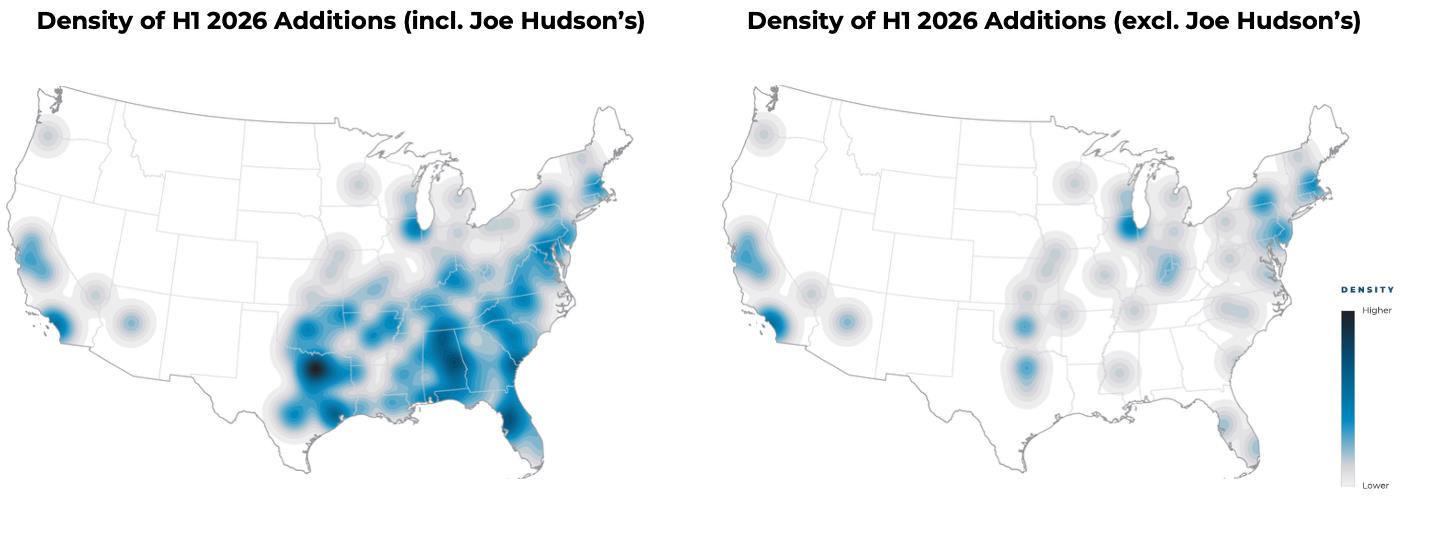
California, Chicago, and the Northeast are drawing attention across all buyer types. Several of the largest buyers continue to pursue brownfield and greenfield projects while their acquisition pipelines take longer to move through closing — and sellers, for their part, are generally holding their ground on price.
Smaller Players Beginning to Accelerate
Smaller private equity-backed MSOs are becoming more active. Collision Leaders, owned by Bestige Holdings, is now buying again — two acquisitions in Kansas and Missouri brought its store count to 13. Driving Force Collision, a tri-state roll-up backed by TRP Capital, grew to seven shops after acquiring Allentown Collision Center in April. Body by Cochran, one of the increasing number of dealer groups building out fully-realized MSOs, kept expanding its Pittsburgh MSO while also diversifying into parts logistics (more on that below).
Perhaps the most conspicuous debut of the half came from Collision Partners, the new roll-up spearheaded by Earl Johnson IV. In January it acquired Chassis Master and Fantastic Finishes, highly-certified shops out of Miramar and West Palm Beach, Florida. In late July — just after the close of the first half — it made bigger waves with its acquisition of K&M Auto Body in Hickory, North Carolina. Collision Partners appears to be targeting shops with high-line certifications with strong dealership and OE relationships, an approach that leans more on dealer and direct-to-consumer marketing than on DRP relationships. Minuteman Collision, led by Gerber’s former head of M&A, Jason Hope, debuted by acquiring four locations across greater Boston.
Buyer Tiers
Here is how the three tiers of acquirers behaved in the first half.
| Buyer Tier | Representative Buyers | H1 2026 Activity |
|---|---|---|
| The Big Four | Gerber, Caliber, Crash Champions, Classic | Selective; integration, pruning, and organic openings over M&A |
| Established Consolidators | CollisionRight, Quality Collision, VIVE, Puget, BrightPoint, G&C, OpenRoad, Chilton, Kaizen | The most active acquirers; generally growing 5–7x faster than the Big Four |
| New Entrants | Collision Partners, Minuteman, Collision Leaders, Driving Force | Building platforms from single shops and small MSOs |
Biggest Deals of the First Half
| Acquired | Acquiror | Shops | Geography | Month |
|---|---|---|---|---|
| Joe Hudson’s | Gerber | 258 | Southeast | January |
| Fix Auto – Richard Fish | Puget Collision | 6 | Southern California | May |
| Carstar Scott Hotalen | VIVE Collision | 5 | New York | January |
| Barnett’s† | Caliber | 5 | Mississippi | July |
| Davis Auto Body | OpenRoad | 3 | Oklahoma | June |
| Cherry Collision ★ FOCUS ADVISORS | VIVE Collision | 3 | New Jersey | March |
| Marina Auto Body ★ FOCUS ADVISORS | Chilton | 2 + intake ctr. | Southern California | March |
| Erie Lasalle | Gerber | 2 | Illinois | February |
| Carstar Blackhills & Carstar Sedona | Puget Collision | 2 | Arizona | April |
| Boyce Body Werks | Gerber | 2 | Illinois | June |
| Chassis Master | Collision Partners | 1 | South Florida | January |
| Fantastic Finishes | Collision Partners | 1 | South Florida | January |
| K&M Auto Body† | Collision Partners | 1 | North Carolina | July |
Capital Is Moving Differently, Not Away
Private equity across the U.S. is underwriting “terrestrial” roll-ups like collision repair more carefully than it did a few years ago, but it has not stopped pursuing them. The reasons include the end of an era of inexpensive debt, high-growth tech companies drawing the spotlight, and pressure on private credit markets. Against a backdrop of fewer portfolio-company exits and longer hold periods, fundraising has been tougher than in years past. The automotive aftermarket, though, is relatively well positioned, with strong secular tailwinds — an aging car fleet, non-discretionary spending, and a high cost of replacement.
Focus Advisors is in touch with more than 130 private equity firms still actively looking at collision repair, and more than $9 billion of capital has been deployed into the sector since late 2023. We do not foresee an end to the private equity-backed consolidation trend. What is different so far in 2026 is where that money has been invested: with few large platforms coming to market, buyers have focused on starting or building out roll-ups one single shop or small MSO at a time, while some longer-standing platforms have shifted from acquiring independent MSOs to growing through greenfield and brownfield development instead.
Much of the restraint has been discipline rather than disinterest; it’s a rational response to revenue compression, repair cost inflation, and a mixed economy. Discipline is what keeps buyers profitable enough to continue buying. On the supply side, we’re seeing plenty of sellers of every profile, from single shops to large MSOs, distressed to growing; what’s limiting deal volume isn’t a shortage of willing sellers, but their recent softer revenue and EBITDA performance and the heightened buyer scrutiny, geographic selectivity, and valuation pressure that comes with it.
On the demand side, several PE-backed consolidators have seen significant C-suite and operational changes, and some have been through recapitalizations or refinancings that put a temporary damper on growth plans. The combination adds up to something of a “Goldilocks window” for nimble, well-capitalized regional buyers: less competition from the largest acquirers, plenty of willing sellers, and more financing available for deals of modest size.
One quieter force shaping valuations is consolidator pursuit of preferential carrier agreements. A seller’s carrier mix and local market concentration now materially affect a buyer’s post-close economics — and, increasingly, the offer itself. Some carriers have been dropping shops from their DRPs as part of a reshuffling of assignments within a state or market, adding fresh uncertainty to the value of a seller’s DRP revenue. At the same time, some buyers are diversifying away from their historical DRP-dependent playbook, putting more — or in some cases, less — weight on those relationships than in prior years.
Sharpening and Diversifying
Against a turbulent backdrop, many operators — large and small — have had to sharpen their focus and diversify their businesses. Sharpening has come in three forms: temporarily closing stores for renovation or converting them to intake centers (and, occasionally, not renewing leases on underperforming locations); personnel changes, including restructurings, layoffs, and leadership turnover across the industry; and an unblinking focus on margins, as operators renegotiate contracts, cut costs, and add or drop DRPs.
Diversification is the other half of the story. As claims counts have gradually leveled out from a steep 2025 decline, and as the average car age has climbed to a record 12.95 years, more operators are diversifying into mechanical and maintenance work. Texas Collision Centers, one of the nation’s prominent independent MSOs, announced its entry into heavy-duty truck repair in the first half. Caliber expanded its fleet solutions business. Body by Cochran expanded its 80,000-square-foot parts warehousing operation serving 500 body shops across the Pittsburgh area, alongside shifting toward brand-specific OEM certifications at each location so each technician can specialize by make. Additionally, operators across the country have been eager to earn Toyota or Rivian certifications — Rivian being the maker of Amazon’s delivery vans.
Where the Industry Stands
The U.S. collision repair industry appears to have found its footing — at a new, lower level, but one that is finally steady enough to plan and price against. Our best estimate is that industry revenue declined just under 5% year-on-year, even as cars remain broadly less affordable and the average total cost of repair keeps climbing; Boyd Gerber said in its Q2 2026 investor report that those cost headwinds have made same-store sales growth harder to achieve. One long-time operator looking to re-enter the space summed up the mood bluntly to us: “the collision industry’s weird right now.”
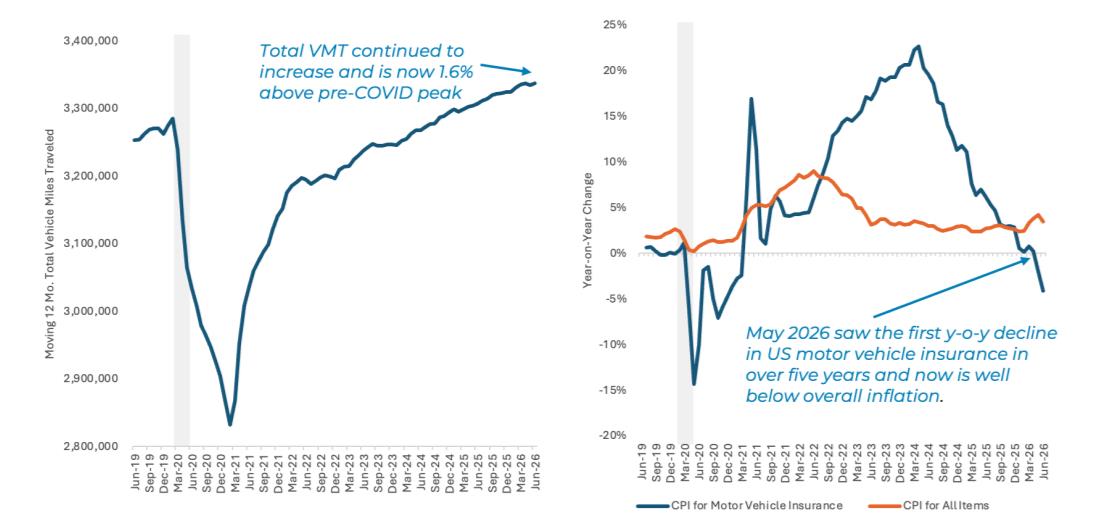
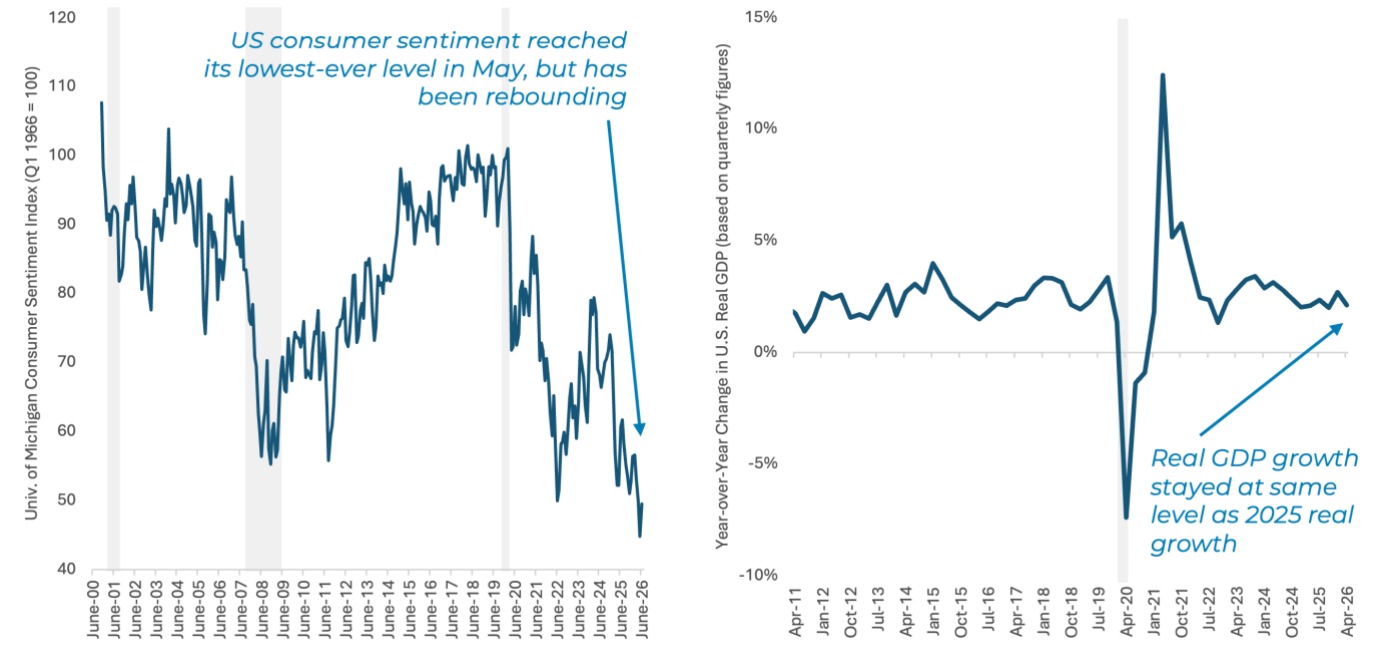
Still, there are real green shoots heading into the second half. The average new vehicle price has come down from its all-time high last year. Boyd Gerber reported flat claims counts year-over-year in Q2, and GEICO has reported an increase in collision claims. Northeast and Midwest operators had their first “real winter” in several years. Auto insurance premiums actually declined year-on-year even as vehicle miles traveled continued to grow versus both last year and pre-pandemic levels. More broadly, real GDP growth remains stable and unemployment has declined versus last year; consumer sentiment, after bottoming out in May, appears to be rebounding.
Tesla Keeps Building
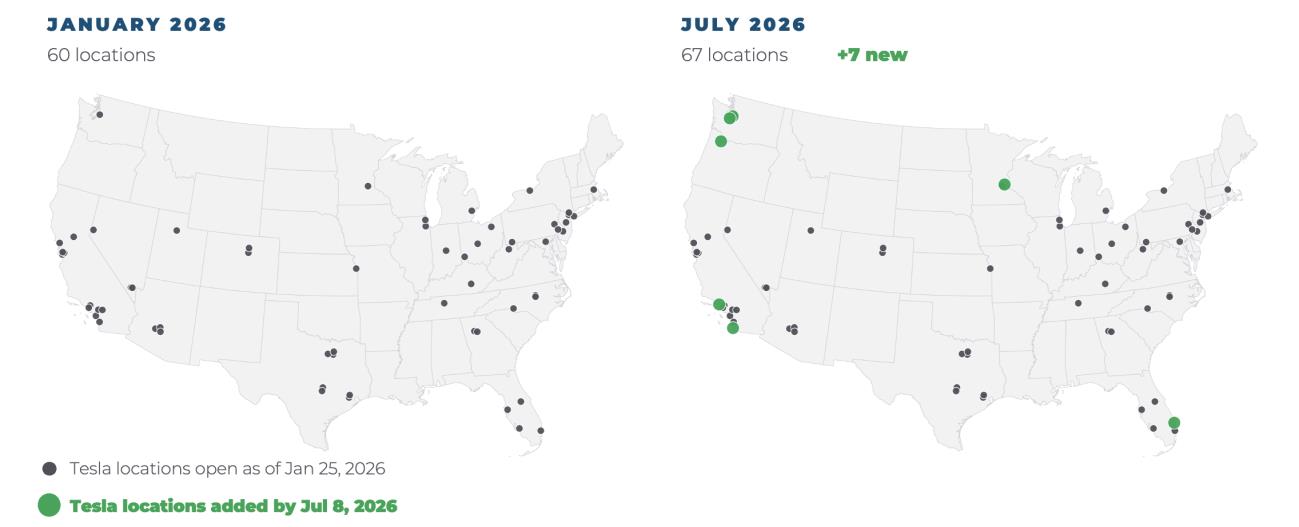
Tesla has continued to build out a formidable collision repair footprint of its own, opening seven large centers in the first half of the year with more slated for the second half — even as Cox Automotive reported an 11% decline in new Tesla sales in H1 2026 versus H1 2025. Every location has been built as a brownfield or greenfield project, and they run large: a 42,000-square-foot facility is under construction in McKinney, Texas, and a 28,000-square-foot facility is planned for Jacksonville, Florida. Our sources indicate five more are in the pipeline in the near term: Hanover Township, New Jersey; Miami, Florida; Cumming, Georgia; Anaheim, California; and Middletown, Pennsylvania.
Meanwhile, effects are felt in M&A as Tesla is using any and all means to revoke certifications across the US. Buyers of collision repair shops are increasingly discounting Tesla-generated revenue when they make their offers.
C-Suite Changes Reflect Industry Dynamics
Senior leadership changes at many of the leading consolidators reflect the challenges of managing an industry moving through dynamic change; the skills and leadership a platform needs at one stage of growth are often not the ones it needs at the next. These changes aren’t unique to collision repair. What is notable, though, is how many of the executives stepping into those seats are industry veterans who began their careers as technicians and center managers.
Among the largest consolidators, Classic Collision’s CEO, Toan Nguyen, stepped down while remaining on the board; Brad Anderson, the former CEO of Pilot Travel Centers, was appointed as his successor in June. Brandon Hawkins, formerly COO of AutoTech Solutions, was named COO of OpenRoad Collision, rejoining his former Caliber Collision colleague Steve Horton, OpenRoad’s CEO. VIVE Collision named Charlie Drake, formerly COO of Classic Collision, as its new COO. In June, long-time board member John Robinson was appointed CEO of CollisionRight and Rich Harrison became Chief Development Officer. Quality Collision Group appointed James D’Onofrio as its Chief Strategy Officer in June to lead corporate strategy and M&A, and, at the time of writing, recruited BrightPoint’s former CEO, Paul Williams, as its new COO, succeeding Matt Robbins.
Following its acquisition of Joe Hudson’s in January, Gerber absorbed several of the company’s former executives: Joe Hudson’s CEO Brant Wilson stayed on for a few months to help integrate before departing in March, while Mitchell Walley, Joe Hudson’s former Director of M&A and Finance, has remained with Gerber. Cameron Dickson, who previously held the COO role at Joe Hudson’s, became the SVP of the South Division. And in April, Gerber hired Steve Hoeft from Bridgestone Americas to become their COO of U.S. Collision.
Beyond Collision: The Aftermarket Stayed Busy
M&A across the broader automotive aftermarket industry was ample in the first half. Dealership transactions were especially active: George Karolis of the Presidio Group reported 215 dealership deals in H1 2026, up 23% from H1 2025, with much of the activity concentrated in the perennially sought-after brands such as Toyota, Mercedes, and BMW.
Other segments of the automotive aftermarket have seen – similar to dealerships – an active first half. Notably, First Brands Group, which entered Chapter 11 last September, began selling off business units, intellectual property, and other assets through court-supervised sales in March and April.
In coatings, Axalta and AkzoNobel’s previously announced merger finally won shareholder approval in August, and Carlyle (the private equity group that made the first institutional investment into Service King Collision Repair in 2012) completed its acquisition of BASF’s coatings business on June 30 (which is now known as Surventis). In technology, Partly raised $50 million to build out AI infrastructure for the automotive supply chain, and Repairify and Opus IVS merged to form a unified diagnostics platform. On the private equity side, Incline Equity Partners sold Certified Collision Group to the Riverside Companies in early January; ADW Capital Management’s April bid to take Driven Brands private was rejected in early August, with deliberations still evolving at the time of writing.
Early into the second half, activist investor Elliott Investment Management built a significant stake in CCC Intelligent Solutions in early July. Also in July, Icahn Enterprises announced a $700 million cash deal to sell the Pep Boys auto service chain to Mavis Tire Express Services.
Noteworthy Aftermarket Transactions (H1 2026)
| Deal Description | Month |
|---|---|
| Incline Equity Partners announced the sale of Certified Collision Group to The Riverside Companies | January |
| Midas International/Mavis acquired large Midas franchisee, the 111-shop Max Auto Supply Co. | January |
| Fisher Auto Parts acquired Cincinnati-based Smyth Auto Parts and its 25 locations across OH, KY, and TN | January |
| PSE Group, a distributor of automotive paint, industrial coatings, and body shop consumables, was acquired by Color Systems (both based in New England) | January |
| ECD Automotive, a luxury custom vehicle manufacturer, was taken private via a short-form merger | March |
| Sun Auto Tire & Service acquired 23 locations from DAS Drive Automotive Services | March |
| Team PRP (Premium Recycled Parts) acquired Recyclers CrossDock | March |
| TPG, Allianz X, and State Farm led a $350M investment in Cambridge Mobile Telematics, the world’s largest telematics and AI company for road safety | March |
| TRP Capital and Battalion Capital Partners closed on a platform investment in Velocity Restorations, a luxe restomod builder out of Florida | March |
| Enlyte closed on its acquisition of PartsTrader | April |
| CenterOak Partners LLC acquired a majority stake of Grismer Tire & Auto Service, with 28 locations across Ohio | April |
| Fullbay, a shop management platform for heavy-duty repairers, acquired Pitstop, an AI-powered predictive maintenance and fleet intelligence platform | April |
| FORT Robotics acquired Mapless AI | May |
| BASF finalized the sale of its coatings business to Carlyle | June |
| B&R Repair, an American vehicle repair and service company specializing in trucks, commercial trailers, and cargo tankers, was acquired by TerraVest Industries and integrated into subsidiary EnTrans International | June |
| James Group Inc. acquired EnovaPremier, a Tier 1 automotive supplier of tire and wheel assembly, sub-assembly, and just-in-time sequencing for major OEMs | June |
| Partly raised a $50M Series B at a $500M valuation | June |
| Arxis, Inc. (sponsored by Arcline Investment Management) acquired MagCanica, Inc. | June |
| Snap-on purchased Diesel Laptops, a software provider for heavy-duty diagnostics, technical support, and technician training for commercial trucks | June |
Expectations for the Second Half
We are hearing from several consolidators that revenues have stabilized or even returned to growth year-over-year; while that often represents a lower bar than a few years ago, most describe it as a “new normal” rather than a temporary trough. Industry insiders also tell us several larger, more established consolidators are now accessing new lines of credit and additional capital to recommence acquisitions. With significant transactions in process among Focus Advisors clients, our expectation is that this second half of 2026 and the first quarter of 2027 will see a return to a more robust volume of transactions.
Sellers anchored to their peak-year numbers should still expect to recalibrate if their trailing twelve-month EBITDA remains below its high-water mark, even as acquisition activity picks back up. Moreover, the volume of single-shop operators looking to exit has grown dramatically higher. Sellers in markets where acquirers are committing new capital should be able to find ready buyers.
What This Means for Multiples
Word on the street is that valuations are down. That’s mostly right on the outcome and mostly wrong on the cause. EBITDA multiples for premium assets are holding firm. Where total valuations have declined, it’s primarily because trailing-twelve-month EBITDA has declined, not because buyers have compressed their multiples. The math shows that what we walked through in February still governs: at a 7.0x multiple, a 10% revenue decline can translate into a 20% or more drop in enterprise value. Multiples have held; the valuation question is now an operating question, and it’s one owners can laser-focus on as they prepare for an exit.
If you’re an owner trying to read whether now is the moment to exit — or whether to wait for the next wave — we’d welcome a confidential conversation. Our team advises owners across the full spectrum of deal sizes and stages. Reach out to start a confidential conversation.
About Focus Advisors
Focus Advisors is one of the automotive service industry’s leading M&A advisory firms, partnering with high-performance independent shops and MSOs with $10M to $100M in annual revenue, helping owners achieve maximum value through strategic growth and exits. The Focus Advisors team has advised on more than 120 automotive M&A transactions, including the sale of some of the largest MSOs and franchisors in the collision repair industry.
Investment Banking Services and Securities offered through Independent Investment Bankers Corp., a broker-dealer, Member FINRA/SIPC. Focus Advisors is not affiliated with Independent Investment Bankers Corp.
Note: Chart data and statistics on industry shop counts and acquisition volumes represent best estimates from available public information and proprietary data of Focus Advisors.